
The Most Dangerous Sleeping Position You Didn’t Know You Had
We spend roughly one-third of our lives asleep. That’s thousands of nights. Tens of thousands of hours. Entire years of our existence spent in one recurring posture — vulnerable, unconscious, unaware.
We obsess over mattresses. We debate pillows. We track sleep cycles with wearable tech.
But what if the real issue isn’t how long you sleep…
It’s how you sleep?
There’s one sleeping position many people default to without thinking — one that feels comfortable at first, even cozy — yet quietly strains the body night after night.
And chances are, you’ve used it.
Let’s talk about the most dangerous sleeping position you didn’t know you had.
The Stomach Sleeper’s Trap


If you sleep on your stomach — face turned to one side, one knee slightly bent, maybe an arm tucked under your pillow — you’re not alone.
Many people find it comforting. It can reduce snoring. It can feel grounding. Some say they fall asleep faster this way.
But here’s the truth:
Stomach sleeping is widely considered the most physically stressful sleep position for the body.
It may feel harmless.
It may even feel natural.
But night after night, it can quietly create long-term issues you don’t connect back to your sleep.
Let’s break down why.
1. Your Neck Is Twisted for Hours
When you sleep on your stomach, your head has to turn to one side so you can breathe.
Think about that for a moment.
Your neck is rotated — sometimes up to 90 degrees — for six to eight hours straight.
Now imagine sitting upright and holding your head turned sharply to one side for that long.
You wouldn’t.
It would ache within minutes.
But during sleep, your body doesn’t correct the posture. Muscles stay strained. Ligaments remain stretched. The cervical spine absorbs the tension.
Over time, this can lead to:
Chronic neck pain
Headaches
Tingling in arms or hands
Reduced range of motion
Worsening posture during the day
And because the damage builds slowly, many people never connect their stiff mornings to their nighttime habits.
2. Your Spine Loses Its Natural Curve
Your spine is not meant to lie flat like a board.
It has natural curves — especially in the lower back. When you sleep on your stomach, your pelvis sinks into the mattress while your torso stays elevated, exaggerating the arch in your lower spine.
This compresses the lumbar region.
That compression can result in:
Lower back pain
Tight hip flexors
Sciatic nerve irritation
Muscle imbalances
You might wake up feeling “tight” or sore without realizing your sleep posture is the culprit.
A mattress upgrade won’t fix a structurally misaligned position.
3. It Can Compress Your Organs
When you lie face down, your body weight presses into your abdomen and ribcage.
For some people, this increases:
Acid reflux
Digestive discomfort
Shallow breathing
Your lungs expand best when the chest can rise freely. Stomach sleeping restricts that movement.
You may not notice this consciously — but your breathing may be less efficient throughout the night.
Over time, that can affect sleep quality.
And poor sleep quality affects everything: mood, metabolism, immunity, and mental clarity.
4. Facial Pressure and Skin Aging
This one surprises people.
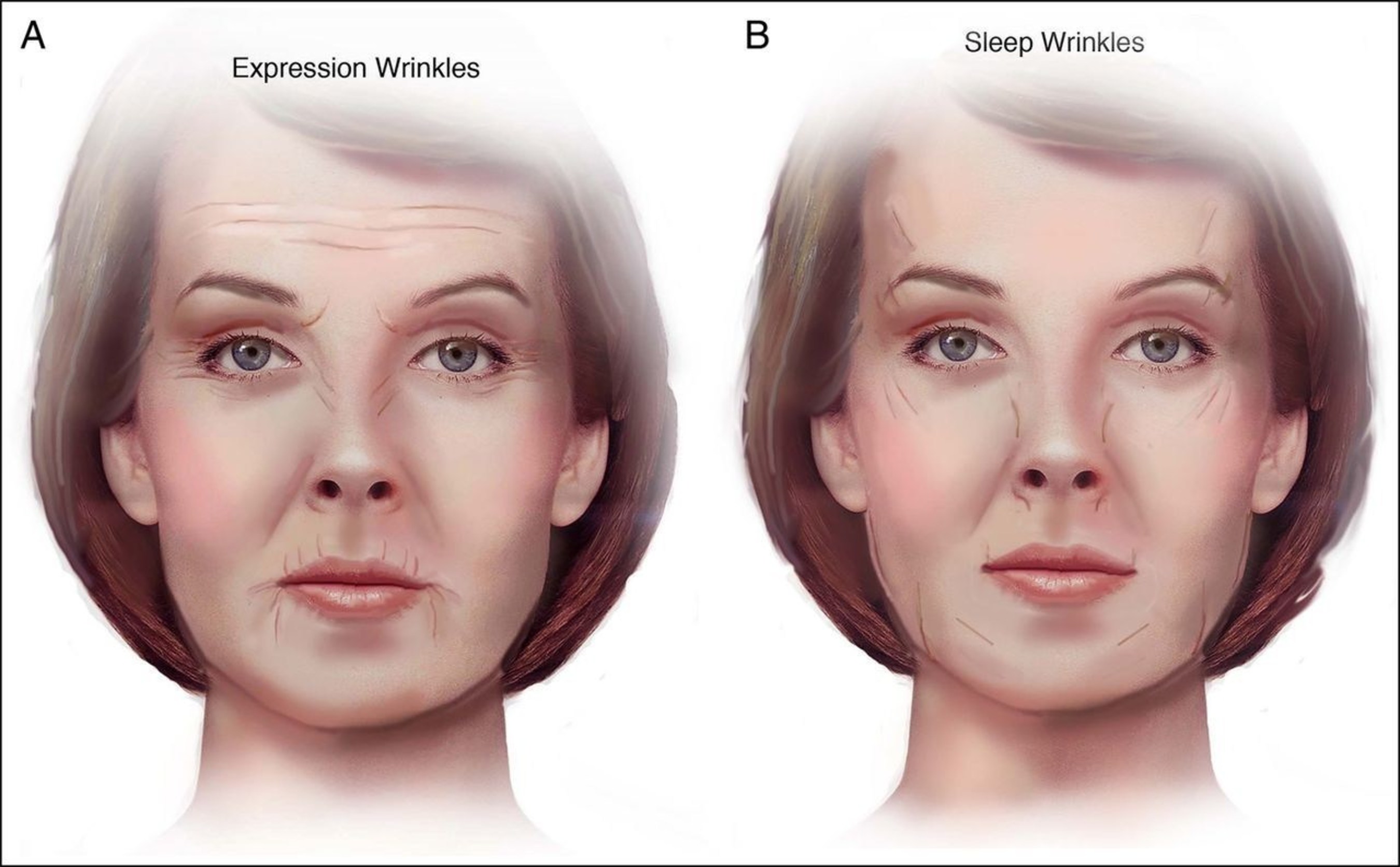
When you sleep face-down, your face presses into a pillow for hours. That repeated compression can contribute to:
Sleep lines that become permanent wrinkles
Puffiness
Uneven skin pressure
Increased acne (depending on pillow hygiene)
It sounds cosmetic — but it reflects something deeper:
Prolonged pressure reduces circulation.
And circulation is vital for tissue repair and recovery during sleep.
5. Nerve Compression in the Arms
Many stomach sleepers tuck one arm under their pillow or under their body.
If you’ve ever woken up with a numb arm or tingling fingers, this could be why.
Keeping the shoulder rotated forward and the arm compressed for hours can irritate nerves that run from the neck through the shoulder and down into the hand.
Over time, this can contribute to:
Shoulder impingement
Rotator cuff strain
Thoracic outlet–like symptoms
Persistent numbness
It may start occasionally.
But repeated compression becomes cumulative.
Why It Feels So Comfortable
Here’s the tricky part.
If stomach sleeping is so stressful, why do so many people prefer it?
There are a few reasons:
It reduces snoring for some individuals
It creates a “hugging” sensation against the mattress
It can feel emotionally comforting
It may reduce anxiety in certain sleepers
Sometimes, the position feels protective. Safe. Grounded.
And that emotional comfort can override physical strain — at least temporarily.
But comfort and alignment are not always the same thing.
Who Is Most at Risk?
While stomach sleeping isn’t ideal for most people, it’s especially risky for:
Individuals with chronic neck pain
People with herniated discs
Those prone to migraines
Anyone with lower back instability
Pregnant individuals (particularly later stages)
Children and teenagers can also develop posture habits early that affect spinal development long-term.
If you wake up frequently with stiffness or headaches, your sleep position deserves a closer look.
What’s a Safer Alternative?

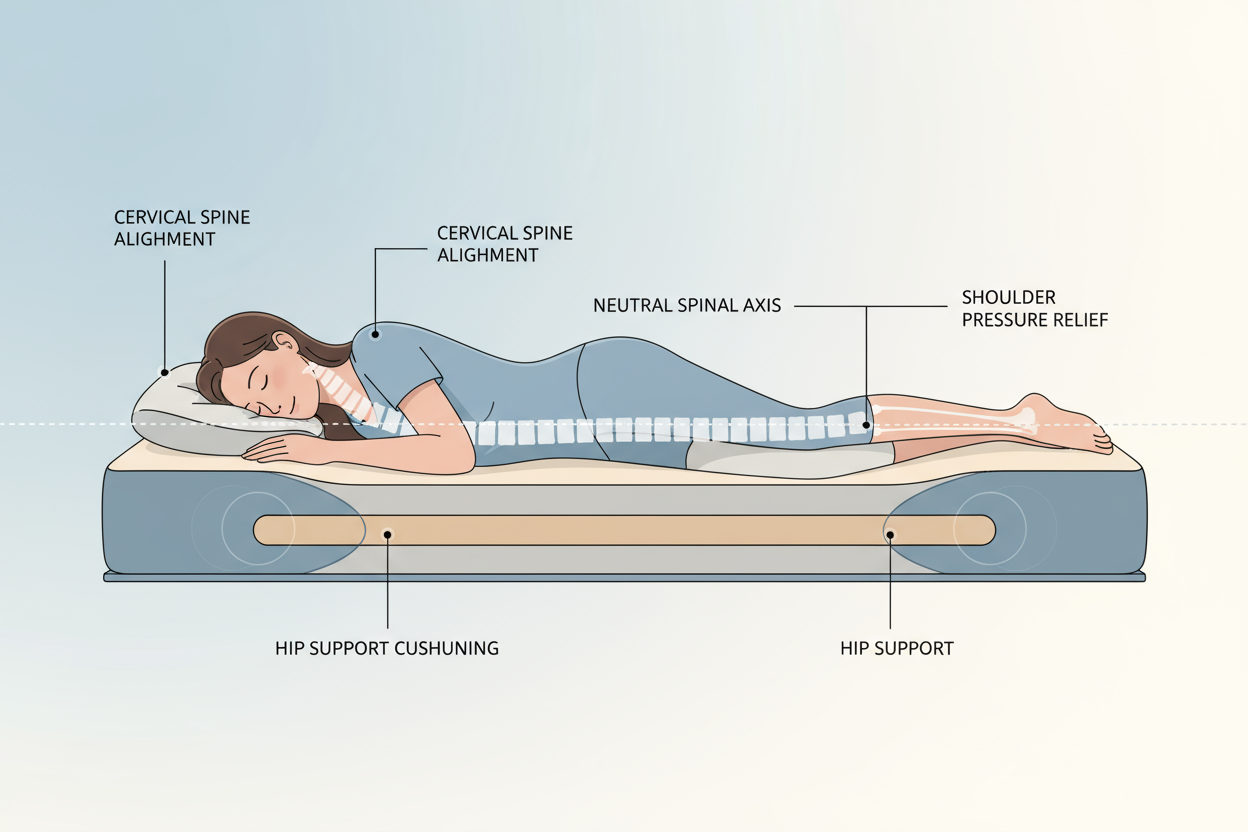
The two most spine-friendly positions are:
1. Side Sleeping (with Support)
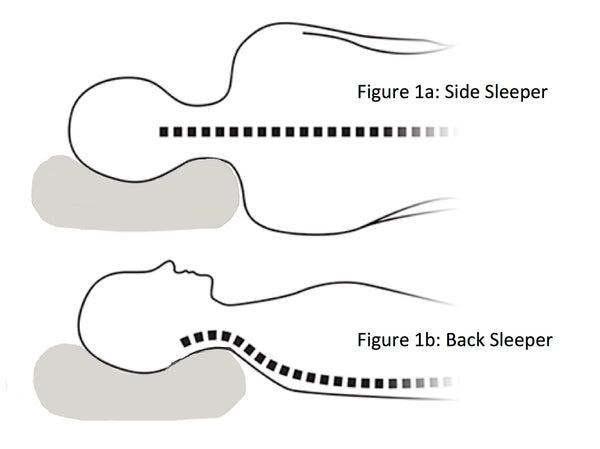
When done correctly, side sleeping can maintain spinal alignment.
Best practices:
Place a pillow between your knees
Keep your head aligned with your spine (not tilted upward)
Avoid curling too tightly into a ball
This reduces lower back strain and supports natural curves.
2. Back Sleeping (Neutral Position)
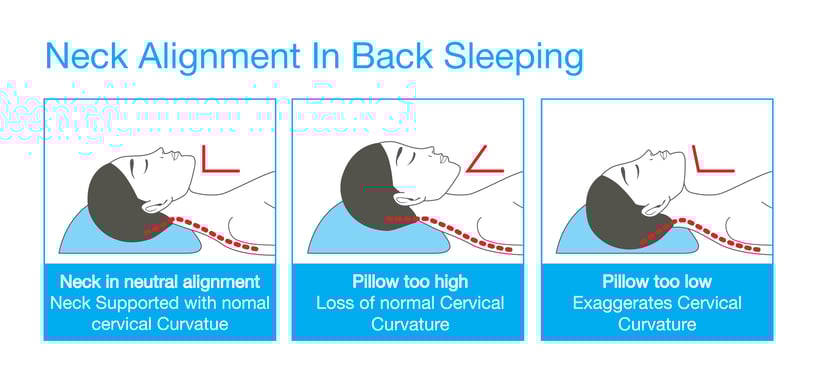
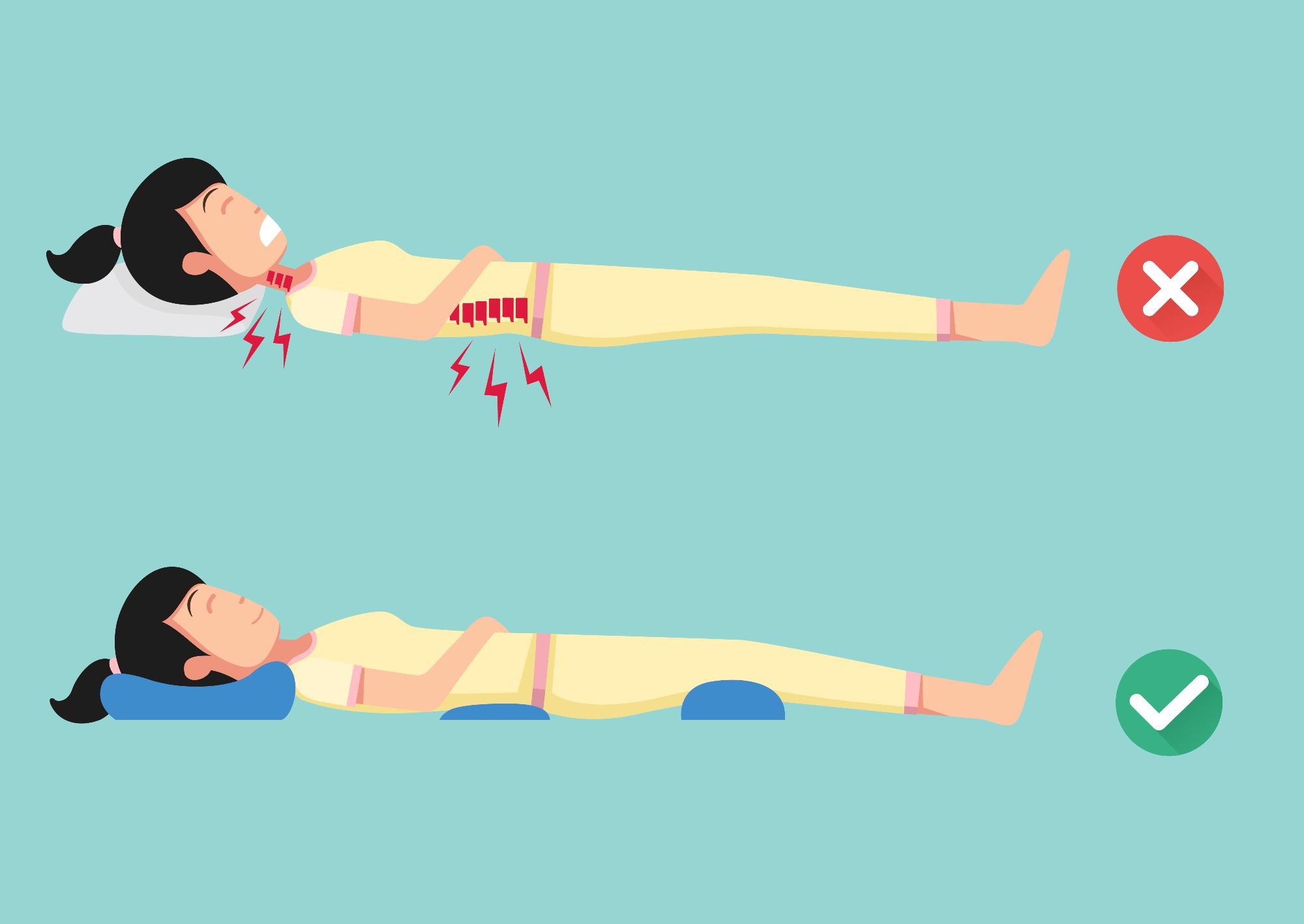
Sleeping on your back distributes weight evenly and keeps the spine neutral.
To optimize:
Place a small pillow under your knees
Use a supportive but not overly thick pillow under your head
This position reduces neck twisting and spinal compression.
However, back sleeping may not be ideal for people with severe sleep apnea.
“But I Can’t Fall Asleep Any Other Way”
Changing sleep positions isn’t easy.
Your body develops habits. Muscle memory kicks in. You may roll onto your stomach without realizing it.
Here are practical ways to transition:
1. Use a Body Pillow
It provides the same “hugging” comfort stomach sleepers crave — but keeps you on your side.
2. Create Physical Barriers
Place pillows on either side of your torso to prevent rolling over.
3. Adjust Your Mattress Firmness
Too soft? Your hips sink.
Too firm? You compensate by twisting.
Medium-firm mattresses often support alignment best.
4. Be Patient
It can take 2–4 weeks for your body to adjust.
Temporary discomfort doesn’t mean the new position is wrong — it means your muscles are adapting.
When to See a Professional
If you experience:
Persistent morning headaches
Chronic neck stiffness
Radiating arm pain
Ongoing lower back pain
Consider speaking with a healthcare professional or physical therapist.
Sleep posture is often overlooked in diagnosis — yet it plays a major role in musculoskeletal health.
The Bigger Picture: Sleep Is a Healing State
Sleep is when your body:
Repairs tissue
Consolidates memory
Balances hormones
Regulates immune function
But healing requires alignment.
If your body is fighting strain all night, you’re not fully recovering.
The goal isn’t perfection.
It’s awareness.
The Surprising Truth
The most dangerous sleeping position isn’t the one that feels worst.
It’s the one that feels fine — until years later, when stiffness becomes chronic pain.
Stomach sleeping rarely causes sudden injury.
It causes slow, silent stress.
And because it happens gradually, it hides in plain sight.
A Gentle Shift, A Powerful Impact
You don’t need to overhaul your entire life tonight.
But tonight, notice:
How do you fall asleep?
Where is your head turned?
Are your hips tilted?
Are your shoulders compressed?
Awareness is the first step toward change.
And change, even small change, can transform how you wake up.
Final Thoughts
We tend to think of danger as dramatic — sharp, loud, immediate.
But sometimes danger is subtle.
It’s a habit repeated thousands of times.
A position held for years.
A strain we normalize.
If you’re a stomach sleeper, this isn’t about fear.
It’s about information.
Your body carries you through everything — your work, your relationships, your passions.
It deserves rest that restores, not strains.
Tonight, try shifting to your side. Support your spine. Align your neck.
Your future self — the one who wakes up without stiffness, without tension, without that lingering ache — might thank you.
Because sometimes the most powerful health upgrade isn’t a supplement or a gadget.
It’s simply the way you sleep.


0 comments:
Enregistrer un commentaire